Visit our main site www.danga.biz
Showing posts with label Government. Show all posts

Friday, December 19, 2008

Is Electronic Invoicing taken hostage by technology companies ?

Recent surveys identified a number of barriers for the introduction of electronic invoicing including the perception of complexity, unclear legislation and absence of standards. The largest obstacle to the adoption and the use of electronic invoicing are ambiguous laws and regulations.

Although the laws and regulations have changed in the past years this feeling remains present among many of us. Especially cross-border invoicing does not seem to come from the ground - mainly - due to these laws and regulations.

Is all of this caused by ambiguous laws and regulations or by the way European authorities and Member States have implemented these regulations. One such bottleneck is the regulatory environment surrounding the use of electronic signatures.

What is the regulatory environment surrounding the Electronic signature?

The European Commission on 28 January 2009 adopted a proposal to change the VAT Directive 2006/112/EC (from 28 November 2006) with respect to the invoicing rules. The European Commision published a communication on the technological developments in the field of electronic invoicing (COM/2009/20).

The aim of the proposal is to increase the use of electronic invoicing, reduce burdens on business, support small and medium sized enterprises (SMEs) and help Member States to tackle fraud. This publication includes also measures aimed at further simplifying, modernizing and harmonizing the VAT invoicing rules.

The proposed changes for electronic invoicing are:

- Treat the transmission of paper and electronic invoices equally by removing the conditions for advanced electronic signatures (AES) and electronic data interchange (EDI).

- Notification and acceptance by the receiver of the invoice and Tax Authorities is no longer required instead normal commercial practice will apply.

- Period of storage: Common storage period of 6 years within Europe for VAT invoices.

- Format of storage: Paper invoices may be converted into electronic form for storage purposes. Storage of invoices in original format is no longer required.

- Place of storage: No conditions for the place of storage other than that the invoice must be available without undue delay. The invoice should no longer be online available when held outside the Member State of the supplier or customer.

- Notification of the place of storage: Notification is no longer required.

- Date of supply of an Intra-community transaction = date of chargeability of tax, date when the tax is due to Treasury. The invoice should no longer contain the date of supply but instead the date when the tax is due.

- The invoice has to be issued before the 15th of the month following the date of supply.

The requirements imposed on the authenticity of origin and integrity of content of the invoice are changed by this proposal. The Dutch government adopted the proposal in less than a few weeks after announcement. Just in time for us to tell the Dutch Tax Authorities that we were not going to implement the advanced digital signature for the project Electronic Ordering and Invoicing with the Dutch Tax Authorities which went live in July of 2008.

Going for a technology-neutral solution is the fastest path to adoption of electronic invoicing in Europe. The last year several organizations raised seriously questions on the usage of advanced digital signatures as implemented by most European countries.

1) The Fiscal Committee of the European Tax Advisers - Confédération Fiscale Européenne (CFE) - expressed themselves clearly about the requirement of sophisticated encryption methods for both electronic invoicing and archiving. In their Opinion Statement on VAT formalities from 26 September 2008 - Review of the existing legislation regarding invoicing - they replied on the European Commission's online consultation to ascertain the view of businesses on the existing legislation on VAT invoicing.

“The CFE expresses its major concern about the requirement of sophisticated encryption methods such as for example advanced electronic signatures, for both the electronic invoicing and electronic archiving. There is no evidence that such encryption procedures are necessary.

Complex national encryption requirements imposed on the issuers of invoices are totally useless when the VAT is due from the customer, rather than the supplier, which is the position with many international or intra-community supplies.”

2) The European Association of Craft, Small and Medium-Sized Enterprises aisbl (UEAPME), the European SME umbrella organization, incorporates 83 member organizations from 36 countries consisting of national cross-sectorial SME federations, European branch federations and other associate members, which support the SME family.

The UEAPME replied on the European Electronic Invoicing (EEI) Final Report, the findings of the European Expert Group on E-Invoicing, with the following statement: “There is no need for onerous security measures when it comes to the authenticity and integrity of e-invoicing, particularly when businesses can prove that proper internal control processes are in place. Therefore, equal treatment of paper invoices and einvoices relates foremost to authenticity and integrity. As the experience in practice shows, e-invoicing is used most in those countries which treat paper and e-invoices the same when it comes to integrity and authenticity.”

See document Taskforce reply to EEI Draft Recommendations from 22 September 2008.

Internal business controls, if properly implemented, should be a sufficient reassurance to tax. Although an electronic signature is a method to prove authenticity of origin and integrity of content, the issuance of e-invoices should not trigger the obligation of an electronic signature if authenticity of origin and integrity of content can also be proved by other means.

3) The Expert Group on E-Invoicing advised to eliminate the usage of the advanced digital signature:

“The Expert Group envisages a ‘Model Contract for secure Data Exchange’ as the ‘legal solution’ capable of promoting wider use of e-invoicing by SMEs (in addition to a standard cross-industry ‘basic’ e-invoice and a major role of banks). The ‘Model Contract‘ would not prescribe digital signature but define other ‘simpler’ methods of ensuring an ‘acceptable’ level of authenticity and integrity of the documents exchanged.”

The Communication from the Council to the Commission on the technological developments states: “There is at present no single business-friendly technology to support e-invoicing throughout the EU that satisfies both large and small businesses and has full support of all tax authorities. Moreover, there is no clear prospect of a suitable technology-based solution encompassing the needs of all parties in the next few years. Thus technology should not be relied upon to improve the take up of e-invoicing. “

The Expert Group on E-Invoicing set up by Commission Decision states in an open letter to the Commission: “Any solution to e-invoicing should be technology-neutral as a matter of principle.”

Finally, one cannot formulate it better than done by the Finish Information Society in 2005: “It is all about Trust and Confidence. The first difference of the opinion usually springs from the very attitude towards trust and confidence. In Finland, generally speaking, the initial attitude is trust and confidence with the parties being dealt with, unless otherwise proven. In a number of countries, on the other hand, the starting point is that the opposing parties are all crooked – or at least subject to justified suspicion – therefore security and auditing systems must be on fail proof level. This difference in opinions creates really major differences in demands also for electronic invoices.”

Bo Harald, Chairman EU Commission Expert Group on E-Invoicing, says in his video-statement “there are 238 billions reasons - to begin with ... but we are highjacked by technology companies”. See the e-Business News Channel for the video-statement of Bo Harald.

WE ARE HIGHJACKED BY TECHNOLOGY COMPANIES.


Electronic Invoicing - 238 bilion reasons - to begin with...

Bo Harald

Lesson learned from examinations and investigation of the legal and fiscal regulations and evolution over the past months is that there is no way back from here. The fastest path for adoption of electronic invoicing is a technology-neutral solution where at current there is no place for continuation of the advanced digital signature.

When more countries adopt this proposal towards the 1st of January 2013 the issues of authenticity of origin and integrity of content will have to be embedded in financial systems, procedures and reconciliation of cross-country tax reporting / declarations. Business Control will become the keyword and it is up to us to deal with it.

Tags: electronic data interchange, Government, e-Invoicing

Last update: 26-11-2011

Monday, October 6, 2008

SAP neemt de UN/CEFACT Core Components als basis voor WARP 10

De SAP medewerkers Mark Crawford en Gunther Stuhec hebben de voorbije twee jaar hard gewerkt aan de ontwikkeling van een nieuw modelleer- en transformatiegereedschap gebaseerd op de UN/CEFACT Core Components Specification (CCTS).

Beide heren zijn actief betrokken bij de UN/CEFACT en de CCTS: Gunther is de voorzitter van de UN/CEFACT Techniques and Methodologies Group (TMG) en voorzitter van het project team verantwoordelijk voor de ontwikkeling van de CCTS standaard. Mark is de voorzitter van de UN/CEFACT Applied Technologies Group (ATG), de projectverantwoordelijke voor de UN/CEFACT Naming and Design Rules Specification en het Core Components Harmonization Project.

In het verlengde van hun waardevolle bijdrage aan de UN/CEFACT hebben zij de Core Components Specification als basis genomen voor het ontwerpen van een modelleer en transformatiegereedschap met de werknaam SAP CCTS Modeler Warp 10. De architectuur van Warp 10 is gebaseerd op SAP NetWeaver en biedt zowel integratie en uitbreiding van de SAP Global Data Types (GDT's) als transformatie naar ieder ander logisch data model ongeacht de gegevensbron.

De SAP CCTS Modeler Warp 10 is ontworpen met als doel het verminderen van de ontwikkel- en integratieinspanningen van data modellering en mapping. Het gereedschap richt zich voornamelijk op het vereenvoudigen van de inspanningen voor het bouwen van transformatiedefinities. Daarbij wordt ondersteuning geboden voor het automatisch genereren van transformatiemappings tussen verschillende standaarden op basis van industrie, internationale standaard, berichttype en doel van het bericht.

De SAP CCTS Modelere Warp 10 is een web-gebaseerd gereedschap met repository waarin data structuren, modellen en mapping definities zijn opgeslagen.

Vrij recent (9 juli 2008) is door Gunther Stuhec de Community Advisory Group (CAH) 12 Business Data Interoperability opgericht met als doel het nieuwe prototype van CCTS Modeler Warp 10 een beetje dichter bij het grotere publiek te brengen. De vraag is of het publiek wel interesse heeft in een propriëtair online gereedschap. Het aantal deelnemers en activiteiten aan deze community is vrij beperkt wat meestal geen positief teken is.

Voor het realiseren van integratie tussen bedrijfsprocessen en -systemen is het van groot belang dat een oplossing wordt gevonden voor het interoperabiliteitsvraagstuk. De kern van het vraagstuk is het ontbreken van informatieinteroperabiliteit tussen bedrijfsondersteunende systemen. Al jaren is het één van de beperkende factoren in de realisatie van inter-enterprise collaboratieve bedrijfsprocessen en gegevensuitwisseling. Zoals ik in mijn bloart Hoe lossen we het interoperabiliteitsvraagstuk op ? beschrijf zijn er reeds verschillende benaderingen ontwikkeld maar geen is momenteel voldoende volwassen om als uitgangspunt te dienen.

Ik geloof dat het bedrijfsleven behoefte heeft aan een Open Gemeenschappelijke Intelligente Oplossing die de brug slaat tussen al deze initiatieven en geaccepteerd wordt door de deelnemers in het integratie-speelveld. Daarbij valt te denken aan standaardisatieinstellingen, overheden tot leveranciers van oplossingen zoals SAP maar eveneens Open Source Communities zoals Eclipse.

Last update: 26-11-2011

Tuesday, September 9, 2008

De ABILITIES Interoperability Bus

Het project “Application Bus for InteroperabiLITy In enlarged Europe SMEs” (ABILITIES) is/was een onderdeel van het Sixth Framework programma van de Europese Commissie. Het project was gestart in januari 2005 en kende een looptijd van 2 jaar. Het project had als voornaamste doel het onderzoeken, ontwerpen en ontwikkelen van oplossingen voor het verbeteren van de interoperabiliteit in het bestel-tot-facturatie proces (order-to-invoice procurement cycle).

Ik zal hierna het ABILITIES project verder toelichten maar voor meer informatie kunt u terecht op de website ViewZone.org onder ABILITIES.

Het ABILITIES project richtte zich op de Interoperabiliteit tussen kleine en middelgrote bedrijven in de minder ontwikkelde landen en de minder technologie gedreven industriesectoren. Bedrijven en partners uit Duitsland, Hongarije, Slovenië, Rusland, Lithouwen, Roemenië, Turkije en Italië waren betrokken.

Analyse van de problematiek van Enterprise Interoperabiliteit leidde tot de identificatie van twee focusgebieden - interoperabiliteitslagen (interoperability levels):
- de ontwikkeling van een innovatieve architectuur voor de realisatie van Interoperabiliteit met ondermeer intelligente adaptieve bedrijfsdocumenten en integratie van state-of-the-art languages en standaarden voor Business Process Management en Service Orchestration

- de definitie van Intelligente en Adaptive UBL bedrijfsdocumenten voor de kleine en middelgrote bedrijven in het uitgebreide Europa

Het voorstel was om een gemengde architectuur te ontwikkelen die voor uitwisseling van documenten de voordelen combineert van message-based Service Oriented Architectures en van intelligente systemen.

Functionaliteit van ABILITIES
De ABILITIES architectuur voorziet in een aantal functies waarmee de onafhankelijkheid en autonomie van elke deelnemer wordt gegarandeerd.

Ondermeer volgende functies zijn voorzien:
- Configuration Module (Module voor de configuratie van samenwerking)
Voor de communicatie tussen bedrijven zijn de gegevens van de inkooporder en het definiëren van specificaties van goederen en diensten belangrijk. Wanneer standaard samenwerkingsverbanden of -configuraties niet meer volstaan of ontoereikend zijn dan kan met deze functie gedefinieerd worden in welke gevallen een sessie gestart moet worden tussen twee bedrijven voor het afhandelen van openstaande kwesties.

- Negotiation Rules Engine
Elk bedrijf kan haar algemene regels vastleggen en de speciale regels die gelden voor sommige partnerbedrijven.

- Process Designer
De applicatie ondersteunt het ontwerpen en beheren van bedrijfsprocessen via een Process Designer Module.
Via deze module kunnen procesmodellen gedefinieerd, onderhouden en grafisch weergegeven worden.

- Collaboration Configuration Manager
Via de Configuration Manager kunnen partijen verschillende vormen van samenwerking inregelen en inplannen.

Het hart van de ABILITIES architectuur
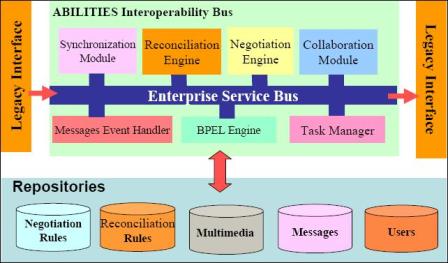
Het hart van de ABILITIES architectuur is de ABILITIES Interoperability Bus (AIB), gerealiseerd op basis van een Open Source Enterprise Service Bus (ESB). Alle componenten die de interoperabiliteit tussen samenwerkende bedrijven ondersteunen worden gekoppeld aan deze ESB zoals aangegeven in onderstaande figuur.

Een ESB heeft als voornaamste taken Messaging, Transformation en Routing. Daarvoor beschikt een ESB over drie centrale eigenschappen:
1) een Message Oriented Middleware (MOM),
2) connectiviteit gebaseerd op Web Services
3) XML- en SOAP-Messaging and Routing

Voor de Enterprise Service Bus is in het ABILITIES project uitgegaan van Apache ServiceMix. Apache ServiceMix is een Enterprise Service Bus (ESB) die de functionaliteit van Service Oriented en Event Driven Architectures combineert.

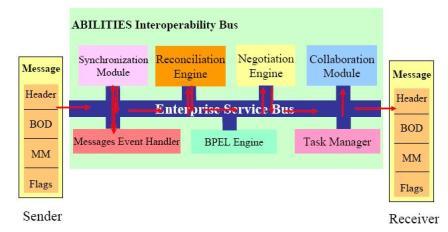
Belangrijk gegeven is dat het ABILITIES project uitgaat van de OASIS UBL specificaties voor het uitwisselen van bedrijfsdocumenten tussen afzender en ontvanger. Daarmee bevestigd UBL nogmaals vrij algemeen geaccepteerd te zijn als berichtenstandaard binnen Europa.

Volgens de informatie die ik verder kon vinden heeft het ABILITIES project niet geleid tot een oplossing die daadwerkelijk in gebruik genomen is. De opgedane kennis en ervaring wordt wel weer in andere projecten ingezet en/of toegepast ondermeer door het Software Research & Development Center van de Middle East Technical University (METU) in Turkije.

Het architectuurconcept van ABILITIES zou naar mijn mening in de Open Source wereld opgepakt en verder uitgewerkt kunnen worden. Een combinatie met ChainBuilder van BosTech zou tot iets moois kunnen leiden.

Hint: Op de website van CORDIS (Community Research & Development Information Service) kunt u meer informatie vinden over projecten die uitgevoerd worden binnen het Sixth Framework programma van de Europese Commissie.

Last update: 3-12-2011

Friday, July 18, 2008

Wordt UBL, de elektronische communicatiestandaard in Europa ?

In september 2001 is op voorstel van een aantal leden van OASIS (Organization for the Advancement of Structured Information Standards) waaronder Sun Microsystems, Commerce One, SAP en Boeing de OASIS Universal Business Language Technical Committee (UBL TC) opgericht. Het voornaamste doel van de UBL TC, voorgezeten door Jon Bosak (Sun Microsystems), was / is het ontwikkelen van een gratis bibliotheek van gestandaardiseerde elektronische op XML gebaseerde bedrijfsdocumenten.

De ontwikkeling van UBL is gestart gedeeltelijk als reactie op de veelheid en verscheidenheid aan XML standaarden / bibliotheken voor elektronische handel maar eveneens om de toegankelijkheid van elektronische handel te vergroten. UBL moet elektronisch zakendoen voor kleine en middelgrote bedrijven mogelijk maken en de basis leggen voor de wereldwijde overgang van traditioneel zakendoen naar elektronische handel.

De OASIS Universal Business Language (UBL) is gebaseerd op de XML Common Business Language xCBL versie 3.0 van Commerce One. Commerce One nam in 1999 het bedrijf Veo Systems over en kwam zo in het bezit van de Common Business Language (CBL) technologie. Deze technologie is door Commerce One verder uitgebreid en omgedoopt tot xCBL om de relatie met XML te identificeren. De XML Common Business Language (xCBL) is een verzameling van XML bouwstenen en een raamwerk voor de ontwikkeling van herbruikbare XML berichten. xCBL richt zich op documenten en transacties ter ondersteuning van de internationale elektronische handel. Commerce One heeft de versie 3.0 van xCBL ingebracht in de OASIS UBL Technical Committee als startpunt voor de ontwikkeling van UBL.

Op70 version) vrijgegeven aan het publiek voor review waarna in november 2004 de eerste officiële versie van UBL, release 1.0, na drie jaar ontwikkeling werd uitgebracht. Twee jaar later, november 2006, werd UBL 2.0 uitgebracht en als formele standaard geaccepteerd door OASIS.

De Universal Business Language maakt gebruik van XML Schema’s voor het beschrijven van gestandaardiseerde bedrijfsdocumenten. Een XML Schema Definitie Document (XSD) beschrijft de structuur van een XML document. UBL 2.0 ondersteunt 31 bedrijfsdocumenten (document types) en voor elk document is een XSD Schema opgesteld.

Verschil tussen UBL 2.0 en UBL 1.0
Een belangrijk verschil tussen UBL 2.0 en de voorgaande releases is het gebruik van een getrapt (twee-fase) validatiemodel. Tijdens het verwerken van een UBL bericht moet de structuur en het juist gebruik van gestandaardiseerde codes worden gevalideerd. UBL maakt gebruik van internationaal gestandaardiseerde codelijsten, verzameling van toegestane waarden, die worden uitgegeven en onderhouden door standaardisatie instellingen, waaronder ISO (landencodes) en UN/CEFACT (valutacodes, eenheidsmaten, taalcodes). Codelijsten kunnen ook gebruikt worden voor het vastleggen van afgesproken waarden tussen twee of meer handelspartners.

In de voorgaande releases werden de verzameling toegestane waarden of codes rechtstreeks vastgelegd in de XML Schema’s van de bedrijfsdocumenten en kon validatie van structuur en codes gelijktijdig uitgevoerd worden. In UBL 2.0 worden de codelijsten vastgelegd in afzonderlijke configuratiebestanden en kan een getrapt validatieproces gevolgd worden. Hierdoor is het mogelijk om verschillende versies van een codelijst te hanteren per situatie. Zo kan per bedrijf waarmee zaken gedaan wordt een andere versie van een codelijst gehanteerd worden.

UBL 2.0 schema’s ondersteunen het gebruik van een getrapt validatie proces dat schematisch als volgt wordt weergegeven en bestaat uit twee stappen (fasen):

- Stap 1: Controle op structuur, data typing en vocabulary via UBL XSD bestanden en een generieke XSD validator
- Stap 2: Controle op het juist gebruik van waarden uit de codelijsten via UBL XSLT bestanden en een generieke XSLT processor. In deze stap vindt validatie van internationaal gestandaardiseerde codes plaats via de standaard UBL 2 .xsl bestanden en validatie van trading-partner specifieke codes via de customized .xsl bestanden.

Hoe staat het met het gebruik van UBL voor elektronisch zakendoen
Wereldwijd is UBL in gebruik als de elektronische berichtenstandaard voor elektronisch zakendoen tussen bedrijven en overheden. Binnen Europa lopen een aantal landen voorop in de ontwikkeling van een elektronische communicatiestandaard voor elektronisch zakendoen tussen bedrijven en overheden.

Denemarken (National IT and Telecom Agency)
Denemarken heeft de invoering van elektronisch factureren vrij rigoureus aangepakt. Vanaf 1 februari 2005 mogen overheidsinstellingen in Denemarken - dit werd zo vastgelegd in de wetgeving - alleen facturen van leveranciers accepteren in een elektronisch formaat, de OIOXML Electronic Invoice. De OIOXML (Open public Information Online XML) Electronic Invoice is de Deense XML-standaard voor de elektronisch factuur gebaseerd op de eerste versie van UBL release 0.7. Voor meer informatie: OIOXML Electronic Invoicing.

Bedrijven kunnen op een aantal manieren facturen aanleveren:
1) via het aanmaken en verzenden van een elektronische factuur vanuit het facturatie-systeem via de elektronische postbus van een Value Added Network (VAN).

2) via een Read-In Bureau die zorgdraagt voor het scannen en converteren van een papieren factuur naar het elektronische formaat en het verzenden van deze elektronische factuur naar de juiste overheidsinstelling via een Value Added Network.

3) via het handmatig invoeren van de factuur in een Internet Invoice Portal die zorgdraagt voor het aanmaken van de factuur in het elektronische formaat en het verzenden van deze elektronische factuur naar de juiste overheidsinstelling via een Value Added Network

Schematisch ziet dit er op hoofdlijnen als volgt uit:

De Deense overheid stelt volgende eisen aan de informatie in de factuur:
- het gebruik van de EAN locatiecode voor identificatie van de klant is verplicht en de klant moet de EAN code verstrekken tijdens het plaatsen van de order
- een referentie naar de inkooporder of bestelling is verplicht
- een referentie naar de persoon die de order heeft geplaatst is verplicht
- interne identificatiecode van de klant is verplicht als deze verstrekt werd tijdens het plaatsen van de order

Let op: Denemarken maakt vooralsnog geen gebruik van de OIOUBL Invoice. De OIOUBL standaard wordt wel aanbevolen voor het uitwisselen van elektronische catalogi en inkooporders. OIOUBL is gebaseerd op UBL release 2.0 (Voor informatie: Online OIOUBL Documentation)

Noord-Europa
Northern European Subset (NES) is een initiatief dat voortvloeit uit de samenwerking tussen enkele Noord-Europese landen op het gebied van e-commerce en e-procurement. Onder aanvoering van Denemarken hebben vertegenwoordigers van de Noord-Europese landen Denemarken, Zweden, Noorwegen, Ijsland, Finland en van het Verenigd Koninkrijk begin 2007 een werkgroep opgericht voor het ontwikkelen van een Noord-Europese Subset (Northern European Subset (NES)) van op UBL 2.0 gebaseerde documenten.

De NES organisatie heeft de Universal Business Language (UBL) geselecteerd als de Open berichtenstandaard - met op dit moment de meeste potentie - voor het realiseren van grootschalige e-commerce en e-procurement handelstransacties tussen overheden onderling en bedrijven, zowel grensoverschrijdend (cross-border) als nationaal (domestic).

Het NES project richt zich niet op het uitvoeren van implementaties maar heeft als voornaamste doel zorgdragen voor het tot stand komen van een gezamenlijk platform voor e-procurement.

De belangrijke resultaten van het NES project zijn:
- Profielen die bedrijfsprocessen en scenario’s beschrijven uitgaande van UBL voor handelstransacties
- Berichtdefinities gebaseerd op een gemeenschappelijke subset (deelverzameling) van UBL handelsdocumenten
- Handleidingen en codelijsten
- Validatiegereedschappen

De aangesloten landen zijn zelf verantwoordelijk voor de uitvoering en coördinatie van implementaties. De laatste versie van NES is op 11 juli 2007 vrijgegeven en kunt u terugvinden onder de rubriek Documents op de website van NES. Al het materiaal van NES is gepubliceerd onder de Creative Common license.

Zweden
In Zweden loopt het project Single Face To Industry (SFTI). Het is een alles-in-één e-procurement standaard waarmee het bestel- en facturatieproces tussen handelspartners wordt ondersteund. Voor het bestelproces is sinds juni 2010 de CEN/BII Basic Order de aanbevolen standaard voor de publieke sector

Duitsland
In Duitsland is deze maand de German Localization Subcommittee (DELSC) samengesteld. Deze gaat zich buigen over de realisatie van een Duitse UBL Data Dictionary.

Spanje
CODICE is het Spaanse overheidsinitiatief voor het ontwikkelen van een verzameling elektronisch documenten gebaseerd op UBL voor de ondersteuning van het aanbestedingsproces. Vereenvoudigd zijn er drie processtappen die worden ondersteund: aankondigen of bekendmaken, aanbieden en gunnen.

De specificaties van de CODICE standaard zijn terug te vinden op de website contrataciondelestado.es.

ABILITIES
Het Europees project “Application Bus for InteroperabiLITy In enlarged Europe SMEs”, kortweg ABILITIES, is gestart begin 2006 en heeft een looptijd van 2 jaar. Het voornaamste doel van het project is het onderzoeken en ontwikkelen van een architectuur gebaseerd op UBL voor de ondersteuning van e-commerce transacties tussen kleine en middelgrote bedrijven (SMEs) voornamelijk in de minder ontwikkelde landen.

ABILITIES voorziet in drie interfaces:
- een Web portaal
- een GUI voor mobiele toegang
- een interface voor legacy systemen gebaseerd op web services

U.S. Department of Transportation (USDOT) Electronic Freight Management (EFM) initiatief
Het Electronic Freight Management (EFM) initiatief richt zich op de promotie en evaluatie van innovatieve e-business concepten. Het is een Research & Development project dat gesponsord wordt door de U.S. Department of Transportation (USDOT). De Electronic Freight Management (EFM) is geïmplementeerd op basis van de Freight Information Highway (FIH) architectuur. De FIH is een innovatieve non-propriëtaire service-georiënteerde architectuur voor de ondersteuning van de coördinatie tussen bedrijfsprocessen en veilige real-time gegevensuitwisseling.

Het EFM maakt gebruik van gestandaardiseerde berichten gebaseerd op UBL waaronder Advance Ship Notice, Dispatch Advice, Receipt Advice en Transportation Status.

Meer projecten en initiatieven staan op stapel en hierover zal ik later berichten.

Tags: electronic data interchange, Enterprise Service Bus, EDIFACT, Government, UBL, UN/CEFACT, CEN/BII

Last update: 3-12-2011

Thursday, July 3, 2008

UN E-Government Readiness Survey (EN)

The European Interoperability Framework (EIF is a set of guidelines and recommendations to enable interoperability of government systems and processes with a view to delivering pan-European e-Government services (PEGS).

The EIF is developed under the IDABC (Interoperable Delivery of European eGovernment Services to public Administrations, Business and Citizens) program. The IDABC program lasted till 31 December 2009 and has been superseded by the ISA program (Interoperability Solutions for European Public Administrations).

What is the ISA program ?
Public administrations are expected to provide efficient public services to businesses and citizens across Europe. ISA, the programme on Interoperability Solutions for European Public Administrations, addresses this need. ISA supports and facilitates efficient and effective cross-border electronic collaboration between European public administrations. The programme enables the delivery of electronic public services and ensures the availability, interoperability, re-use and sharing of common solutions.

Interoperability Frameworks in Europe
Almost all European Governments are in the process of developing and implementing the electronic government. The starting point of the EIF is that each member state has or is actively working on the development of its national Government Interoperability Framework (GIF).

A few examples of frameworks are available on the next websites:
# BELGIF: BELgian Governement Interoperability Framework.

# UK e-GIF: UK e-Government Interoperability Framework.

For a complete overview of the Interoperability Frameworks of all European countries visit the website epractice.eu. Another overview of e-Government initiatives in Europe can be found on Wikipedia: eGovernement in Europe.

Interoperability Frameworks outside Europe
Also governments outside of Europe are working on developing interoperability frameworks:

# New Zealand: NZ E-government Interoperability Framework

# Australia: Australian Government Information Interoperability Framework

# Tasmania: Interoperability Program

The role of the United Nations
The United Nations plays an important role in the promotion of the Interoperability Frameworks. Regularly the United Nations examines the Interoperability Frameworks of the connected countries. The results of the investigation are published on the United Nations Online Network in Public Administration and Finance (UNPAN).

The United Nations Online Network in Public Administration and Finance (UNPAN) is a virtual electronic network that promotes the exchange of expertise and sharing of experiences and lessons learned in public administration and finance at local, national, sub regional, regional and international levels.

On the website of the UNPAN you can find the E-Government Readiness Knowledge Base of the United Nations . The United Nations E-Government Readiness Knowledge Base (UNKB) is a benchmarking tool that provides a comparative assessment for monitoring progress of a country’s e-government readiness.

Yearly the United Nations publishes the Survey e-government readiness. At the begin of the year (2008) the Division for Public Administration and Development Management (DPADM) of the United Nations Department of Economic and Social Affairs (UNDESA) published the UN E-Government Survey 2008: From E-Government to Connected Governance. The survey assesses the e-government readiness of the 192 Member States of the UN according to a quantitative composite index of e-readiness based on website assessment, telecommunication infrastructure, and human resource endowment.

The Scandinavian countries (Sweden, Denmark and Norway) took the top three in the survey followed by the United States. The European countries made up 70 per cent of the top 35 countries with the Netherlands ranked fifth.

The survey can be found on the website of the United Nations Public Administration Network (UNPAN). Open the top level menu Library, go to the option Major Publications and select the item UN E-Government survey.

Last year (2007) the regional centre for the Asia-Pacific of the United Nations Development Program (UNDP) in Bangkok has investigated the Interoperability Frameworks of seven countries including Australia, New Zealand, UK and Denmark. The analysis has been performed under the Asia-Pacific Development Information Programma (APDIP).

The comparisons are intended to provide supplementary information for countries interested in developing their own Governement Interoperability Framework (GIF) and/or updating an existing framework.

During the investigation the focus has been on how Government Interoperability Frameworks (GIFs) in different countries are developed, implemented and maintained. The emphasis has been on the sections: Context, Technical Content, Development Process, Implementation and Compliance.

The Context includes the definition of the GIF, aims of the document, principles that support the selection of standards, scope and limitations, agencies bound by the specifications of the GIF, and the relationship of the GIF with other government documents.

The Technical Content contains the standards and recommendations of the GIF regarding the development of ICT systems and contains a listing of the standards categorized according to the defined interoperability layers.

The Implementation describes the support tools that are provided and/or being developed to aid the widespread adoption of the GIF.

The Compliance references indicators for interoperability, strategies for ensuring compliance, and additional guidance for stakeholders that are provided.

The results are presented in the document e-Government Interoperability: A review of Government Interoperability Frameworks in Selected Countries (GIF-Review.pdf).

Tags: Government, Interoperability-Frameworks

Last update: 26-11-2011